
I've given my first donation via Twitter
I've posted about FORGE in the past (A US based charity that works with displaced communities in Africa). They tried to implement the Kiva model (without the lending part) and it didn't work too well. As a result, Executive Director, Kjerstin Erickson, went public about...
How to use Twitter to raise money
Everyone is ranting about the massive amount raised by Comic Relief. But behind the huge numbers is a great little idea by Peter Serafinowicz, who managed to raise over £5,000 on Red Nose Day with a combination of Twitter and Just Giving. His idea was...
So how much should people give to charity?
There are a great couple of video clips on tacticalphilathropy.com First off is an interview with Peter Singer, author of The Life You Can Save. In case you didn't know, Peter is a professor of bioethics at Princeton University and his new book combines a...
How the direct debit cycle works
I posted a piece last week on Rapidata's paper on what's happening to direct debits in the UK. It can be downloaded here. Have a look. It isn't often you get such a chunk of great information completely free of charge. But just in case...
Return to Melksham
Just before my short break, I had a very interesting conversation with Helen Reynolds of Sue Ryder Care about their pay what you choose pricing experiment in their Melksham charity shop. This has been one of the most popular topics I've covered so I've started...
Direct debit cancellations are on the up - so what?
Rapidata has just released a fantastic report on what's happening to charity direct debits in the UK. If you've read the article in Third Sector, you've just scratched the surface of what you'll find in the actual paper. It's more than a simple document saying...
The true cost of the RBS loss
The Royal Bank of Scotland has just announced the largest annual loss in UK corporate history – 24.1 billion pounds. That's £24,100,000,000. That's $34,200,000,000. That's one brand new classroom for every 80 children living in sub-saharan Africa. That's enough to give clean, safe drinking water...
Why we can afford to be confident
One of the key factors influencing Bluefrog's bullish approach to the impact of the recession on the voluntary sector has been the relatively high levels of economic confidence amongst our key audience. Though the January ICM crisis index indicated that the majority of people (78%)...
Do you want your donors to love your charity?
I remember being at a fundraising conference a few years back where delegates were talking with jealousy about the passion that people had for football teams and rock stars. One person summed up this feeling by saying how he felt when he went to see...
Pay what you choose experiment is a success
I blogged about the Sue Ryder Care charity shop experiment a few weeks ago. For a two week period, all fixed prices were removed from donated items and customers were able to pay whatever they thought goods were worth. In light of the economic downturn,...

The Essentials

Crack the Code to Regular Giving: Insights, Strategies, and a Special Giveaway!
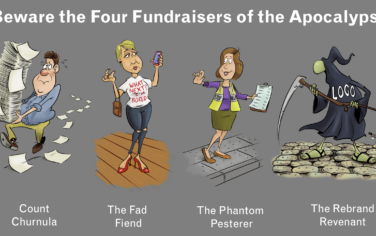
‘Tis Halloween. Keep to the light and beware the Four Fundraisers of the Apocalypse!
Why do people give? The Donor Participation Project with Louis Diez.
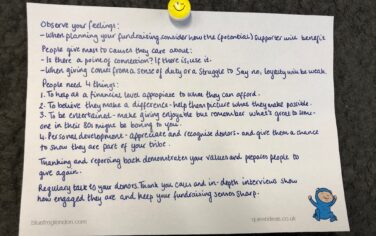
A guide to fundraising on the back of a postcard
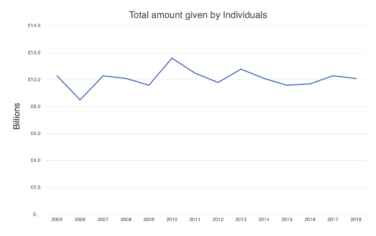
What does the latest research tell us about the state of fundraising?