


Ten questions you should ask at your next creative DM appeal presentation
A list of questions to ask in your next creative presentation to make sure your appeal is built on native understanding rather than non-native guesswork.
I was presenting a fundraising strategy recently to a group of trustees when one of them stopped me mid-slide. I’d shared some images of direct mail packs on screen and he looked puzzled.
“Does this stuff still work?” he asked.
He wasn’t being provocative. He genuinely wanted to know. His uncertainty came from having heard, repeatedly, that direct mail is dead. It was the sort of opinion that turns up in talks about innovation and “the future of fundraising” – those presentations that insist anything old must be obsolete by definition.
As we discussed it, he admitted something else. That he personally gives via direct mail. In fact, he shared that it’s how he likes to be asked for help. But the repetition of this death-knell narrative had begun to override his own lived experience. Direct mail must be dying, he reasoned, because he heard so many people say it.
But as fundraising genius, John Lepp wrote on Friday on LinkedIn, such pronouncements reveal more about the speaker than the medium. Direct mail is notdying. What is dying – what has always died – is poorly constructed, poorly understood direct mail. The kind produced by creatives who have never learned the fundamentals of a fundraising technique built on decades of testing and evidence.
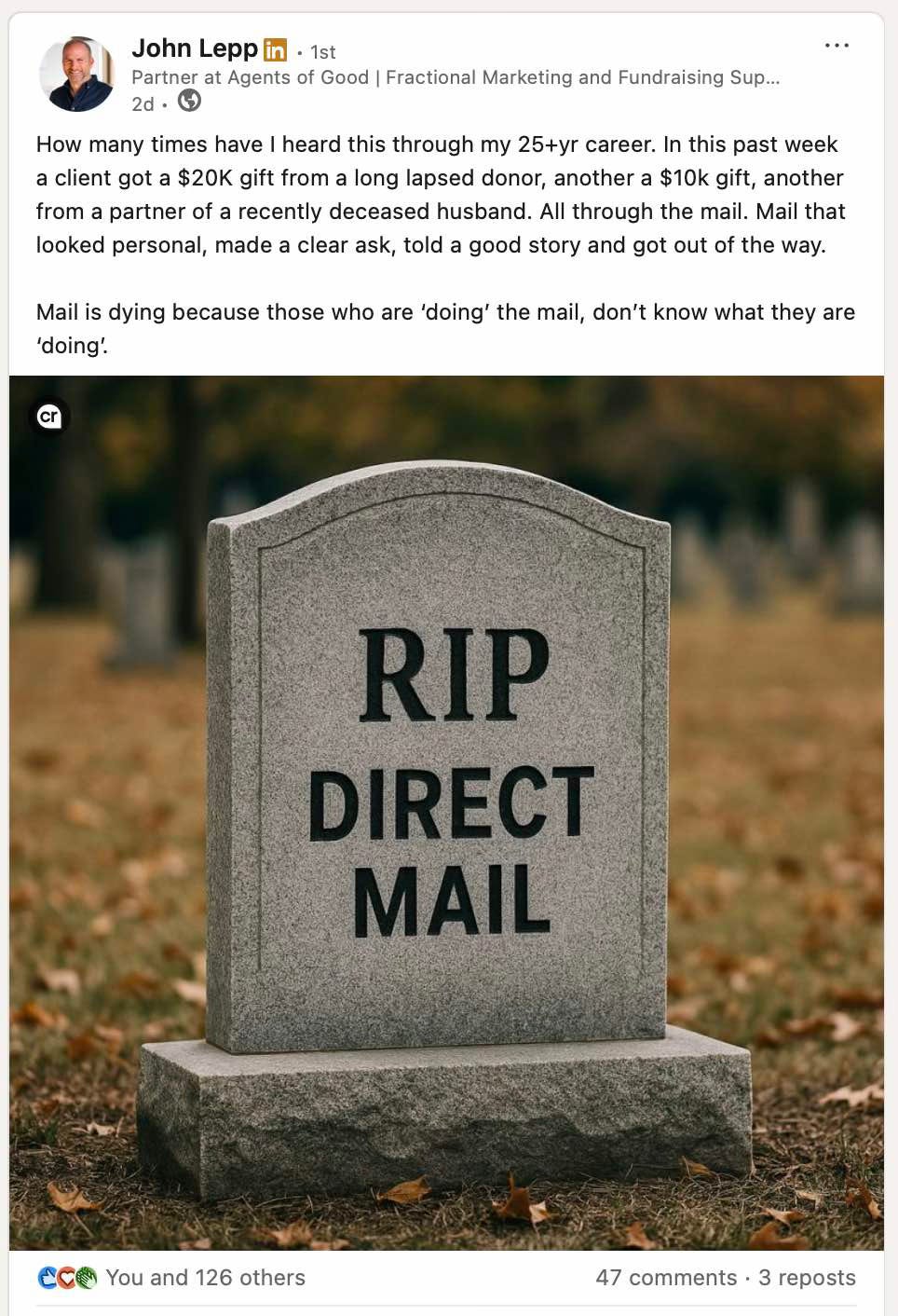
Direct mail is its own world – a medium with mechanical, psychological and tactiledimensions. A native direct mail practitioner understands how all these layers interact. A non-native DM creator might come with digital instincts, an eye for design, or a flair for narrative, but they often lack the deeper knowledge of how proposition, pacing, visuals, annotations, paper stock, inserts and signatory choice come together to create emotional momentum. Without that understanding, even the cleverest creative idea can underperform.
Direct mail is not a place for creativity to run wild. It is more like a machine, where every part must be arranged with intention.
A good proposition is essential. But that is only the start.
Over the run up to Christmas I’ve received a stack of appeals. A handful were genuinely good. Many were surprisingly poor, reflecting the uncomfortable trend that the craft of DM is eroding. Fundamentals are being forgotten. Guesswork is being substituted for knowledge.
Perhaps this is one of the reasons why we read too many stories of charities losing donors and seeing income drop away whilst others report record breaking results? One group understands direct mail, whilst another doesn’t?
So I thought it might be helpful to share a few fundamentals in the form of questions you can ask your agency or creative team the next time they present a DM pack to you. These questions are designed to reveal whether they understand the medium with native expertise, or are approaching it through non-native improvisation.
They can also help you turn an OK pack into a great one.
Why is that envelope going to encourage someone to open it?
The best-performing envelopes nearly always feature the same two things: a handwritten name and address, and a stamp. These outperform almost everything else I’ve tested.
Short of that, a teaser line can work. But only if it speaks directly to the donor’s needs and curiosity. Many years ago, when I worked at YMCA England, the agency we worked with created an appeal with an insert designed as a double-page newspaper spread, printed on actual newsprint. It was a deliberate allusion to the way people sleeping rough use newspapers as makeshift insulation against the cold night air.
On one side was the massive headline…
“Last night 156,000 young people used this as a blanket.”
On the reverse, we laid out the page like a newspaper – stories, images, statistics, explanations of how the YMCA supported young people facing homelessness.
The outer envelope carried a single line..
FREE BLANKET INSIDE.
It was a brilliant teaser. It worked because it was truthful, arresting and aligned perfectly with the offer.
But in the absence of that level of clarity and craft, stick to your core message. Cleverness without strategy rarely wins.
Does that photograph show clear eye contact?
One of the most misunderstood elements of direct mail is the visual. Agencies often treat imagery as a brand exercise rather than a behavioural one. But anyone who has tested images knows the pattern.
- A single face outperforms a group.
- A subject making direct eye contact outperforms one looking away.
- And imagery with no people at all – or someone with their head in their hands – is a reliable way to depress response.
This isn’t mysterious. Humans are wired for faces. Eye contact activates attention. A picture of someone looking - even slightly – to the side simply doesn’t have that same emotional impact. A lone individual looking directly at the reader invites a relationship, whereas a picture of a group diffuses connection and responsibility. And photos of objects or scenery almost never convey the human connection that motivates giving. Donors want to help someone. They need to see that someone.
Why doesn’t the copy talk about the reader?
Another recurring weakness in modern DM is how the reader is considered. So many appeals centre on the organisation – often driven by the brand guidelines – its achievements, its programmes, its strategy. But donors are not motivated by an organisation’s ego. They are motivated by their own identity – who they believe they are, what they want to stand for, what change they want to enact.
The brilliant fundraiser Tom Ahern popularised a simple but highly effective approach - replace every “we” in your draft with “you,” unless it is absolutely unavoidable.
Suddenly the donor becomes the champion, not the audience. And the emotional power of the message transforms.
During a presentation, I once illustrated this point by showing the following photograph. It appeared moments after I’d finished a light-sabre duel with Tom Ahern on stage, whilst he was dressed as Darth Vader.
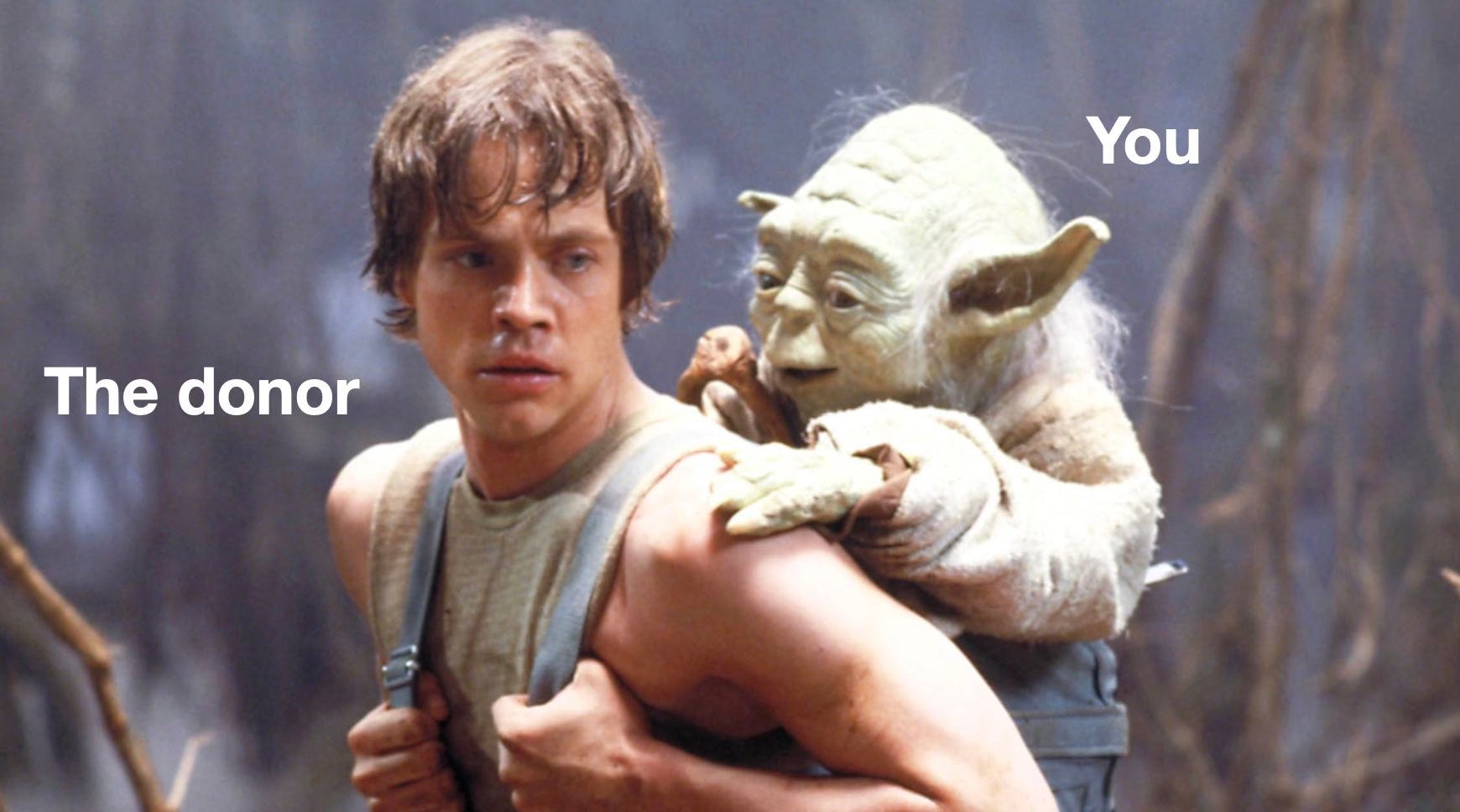
In the Star Wars version of fundraising, you’re Yoda – wise, experienced, aware of what must be done. But your donor is Luke – new to the fight, still learning, yet absolutely vital. The magic happens when you act together, because neither of you wins the battle alone.
Good direct mail doesn’t just present a problem and a solution. It speaks to the donor’s values, hopes and sense of meaning. It says: you believe in this; you want to achieve this; you can do this. People give when the narrative reflects who they want to be in the world.
What are you actually asking the donor to do?
The most effective direct mail appeals rarely present a catalogue of requests. They present one clear thing the donor can picture. For example…
- Buying a Christmas meal.
- Funding an hour of nursing care.
- Provide someone with their first night in safe accommodation.
- Paying for a winter survival kit for a refugee.
These illustrate vivid, tangible ideas. They anchor the entire emotional arc of the appeal. Without such an anchor donors drift. With it, they can immediately imagine the impact of their gift – and once they can see it, they can care about it.
And these examples should always come with a representative price. When donors are left to guess what they should give, they tend to settle around £20. But when you ask for more, and justify it, donors often rise to the challenge. Wealthier donors in particular respond to meaningful, higher asks. Low ask levels don’t empower them – they suppress.
A single tangible request also gives the fundraiser room to build the emotional world around it. Not just what it costs, but what it means – the warmth, the relief, the dignity. Too many modern appeals skip this, jumping straight to transaction.
Please explain the techniques you have used to lay out your letter.
A DM letter isn’t simply read. It is navigated. Skimmed. Browsed. Retained and returned to.
Readers move through it in a non-linear way, and your job is to guide their eyes. Cues like bold text, underlining, and indented paragraphs help shape that journey. Handwritten annotations add intimacy and authenticity. None of these devices are simply aesthetic – they’re functional, and they’ve survived decades of testing for one reason – they work.
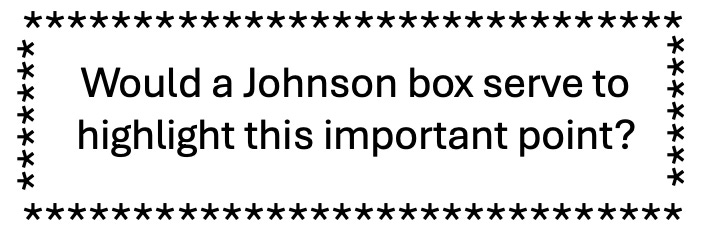
Consider the Johnson box – the device below, that uses asterisks for a border to highlight a specific, important part of your letter. This example gives me the chance to highlight another useful question about letter layout. How do we draw the reader’s eye to what matters most?
And then there is the P.S.
One of the most-read elements in any letter. A good P.S. restates the offer. A great one adds a promise…
“Give today and we guarantee to send you a report showing exactly how your money has made a difference.”
What paper stock will you use for the various parts of the pack?
Direct mail is a tactile medium. The paper matters. The weight matters. The feel matters. And, counterintuitively, cheaper stock often outperforms more premium alternatives. Donors frequently interpret it as a sign of frugality – a signal that their money is going to the cause rather than glossy production. That said, with mid-value appeals the logic can reverse, and higher-quality stock can actually reinforce the sense of importance and care.
But remember that variation of stock within the same pack can be very powerful – a different texture, a different colour, a different finish. Anything that signals this is something unusual increases the chance that you’ll engage the reader.
On this point, I’d also ask the team to walk you through what the appeal looks like the moment it’s opened. It shouldn’t simply be a bundle of paper in an envelope. There should be careful consideration of how each element builds on the one before it, from the outer envelope to the leaflet, to the letter, to the supporting enclosures, to the donation form, and finally to the response envelope.
Tell me how the donation form functions and explain how it reinforces the key messages of the appeal
Organisations often treat donation forms as transactional paperwork. This is a mistake. A donation form can be a moment of relationship-building.
Repeat the appeal on the donation form - explain again - the importance of what you are asking for. Consider how you can emphasise what a gift will buy. Can you use illustrations or photographs to reinforce the value of a gift?
Think about how you can invite donors to send a message to the person they’re helping – or to share why they are giving. Doing so will deepen the emotional value of the gift – and the ongoing relationship.
These comments are gold for stewardship. They reveal not just generosity, but motivation. Use them when thanking donors. As another great fundraiser, Kay Sprinkel-Grace, says: “Show them you know them.”
Why have you chosen that signatory?
And then there is the signatory. Too few organisations understand that donors form relationships with the person who signs the letters they receive. Consistency matters. Changing signatories disrupts the relationship.
The letter should be written with the signatory in mind - and the relationship they have with the reader.
Lift letters – short secondary letters from project workers, beneficiaries, or carefully chosen celebrities – can be used to transform response rates. But the choice must be precise. I’ver seen a well-chosen celebrity more than double response. But the wrong one can depress it.
How have you considered the use of self-definition devices in the pack?
Stickers, bookmarks, or even blank Christmas cards and simple decorations may seem trivial, but they serve a clear purpose. They give donors a subtle way to show off about their support – and define who they are. And that really matters. As individuals, status is woven into how we see ourselves and how we want others to see us. When we offer people a way to express their connection to a cause, we become a more meaningful part of their lives.
There’s another benefit too – people are reluctant to throw away something useful. If they keep it, they keep you, literally, in their homes. That kind of tactile, enduring presence is something digital can rarely replicate.
Direct mail isn’t dying - but bad direct mail should
This collective knowledge exists thanks to practitioners like John Lepp, Tom Ahern, Mal Warwick, Lisa Sargent, Ken Burnett, Mary Cahalane, George Smith, Jeff Brooks, and many others who have spent decades testing, refining and evolving the medium. Their work consistently demonstrates just how powerful DM is. If it’s not working for you, it’s simply being mishandled and perhaps entrusted to non-native practitioners who are relying too much on hunches and guesses rather than evidence.
Direct mail isn’t dying. What’s dying is the willingness to master its details.
And this matters because direct mail remains one of the few moments in modern fundraising where donors sit alone with a message in their hands and quietly consider the kind of person they want to be. It resists the hyper-competitive attention economy that digital occupies.
And among older, wealthier donors – those who still give the lion’s share of charitable income – direct mail is not just familiar. It is preferred. It is where they are native. They may give online, but it is usually the pack that gets them there.
When direct mail is done well. When the images are chosen with precision, the letter speaks directly to the reader, the offer is authentic and exciting, the paper feels right, and the narrative respects the donor’s agency – it still does exactly what it has always done.
It moves people.
The medium is not the problem.
The execution is.
And those of us who understand direct mail know that reports of its death are not just premature – they profoundly underestimate and misunderstand the medium.



The Essentials
Crack the Code to Regular Giving: Insights, Strategies, and a Special Giveaway!
‘Tis Halloween. Keep to the light and beware the Four Fundraisers of the Apocalypse!
Why do people give? The Donor Participation Project with Louis Diez.
A guide to fundraising on the back of a postcard
What does the latest research tell us about the state of fundraising?