


How would you fundraise if fear didn’t hold you back?
“The single biggest block to fundraising growth is fear of criticism.”
That’s what Alan Clayton told us when he joined us for a second visit to the Two Ps on a Pod sofas for a deep dive into the impact of fear on fundraising. And the more you think about it, the more it makes sense.
As fundraisers, we are always being criticised. Obviously we are criticised by politicians or the media. But we are also criticised by colleagues who don’t like fundraising. Or by finance teams who want to minimise expenditure but maximise income - quickly.
Add in social media, the isolation of remote working, and the ease with which anyone can broadcast their opinions, and the fear of criticism has never been stronger. The result is predictable – charities hold back. They soften their messages, they avoid emotion, they cut investment, and fundraising income flatlines.
Alan points to a way forward, and it comes from an idea borrowed from Jim Collins’ Good to Great and is reinforced by Adrian Sargeant’s research.
Collins described five levels of leadership…
- Highly Capable Individual – makes productive contributions through talent, knowledge, and skills.
- Contributing Team Member – works effectively with others in group settings.
- Competent Manager – organises people and resources toward effective objectives.
- Effective Leader – builds commitment to a compelling vision and sets high performance standards.
- Level 5 Executive – creates enduring greatness through the paradox of fierce resolve and personal humility.
It’s that last category that matters most for charities. The organisations that grow their fundraising dramatically - doubling, tripling, sometimes more – are almost always led by someone with those Level 5 traits. They’re tough, but their toughness comes from an unshakable commitment to purpose rather than ego. They’re humble, willing to learn and to listen. And above all, they keep going when others would give up.
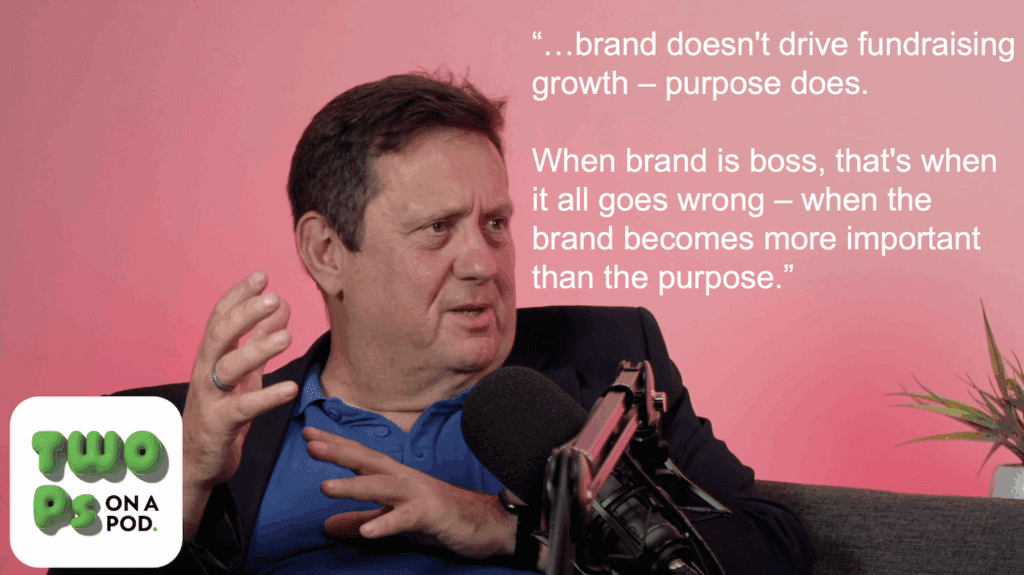
As you’ll see, one of the most interesting threads in the discussion was about brand. Too many charities allow “brand” to become the boss as it’s seen as the best way to avoid criticism.
But brand doesn’t drive fundraising growth. Purpose does.
Fundraising grows when purpose is boss – when the cause leads, when the problem is described honestly, and when donors are given the chance to do something meaningful about it.
Alan highlights the three big decisions that leaders must make…
- The first is to commit to clear, powerful, emotional messaging.
- The second is to build a culture where fundraising is respected and can move quickly without being tied up in bureaucracy.
- The third is to treat fundraising as a long-term investment, not a short-term cost.
Taking these decisions isn’t necessarily going to be easy. All invite criticism. But they are the difference between growth and stagnation.
Underlying all of this is the reality that charities are, in effect, two businesses with one mission.
- Services need servant leadership – leaders who support teams so they can deliver.
- Fundraising needs transformational leadership –leaders who drive relentless focus on growth and ambition. Both approaches are valid and necessary. The real challenge is for leaders to recognise the difference and to hold the tension between them.
So what does this look like in practice?
The best fundraising directors don’t just sit at their desks or work just with their internal teams. They spend huge amounts of time building trust with colleagues across departments. They act as the donor’s advocate inside the organisation. They insist on urgency when it’s needed. They take people out for coffee, for lunch, for conversations that smooth the way when the next big decision comes. They bring in external specialists and sector champions. And above all, they inspire with possibility.
They don’t just present a list of needs – they paint a picture of what could be achieved and make it irresistible.
At the end of the day, the CEO is the make-or-break figure. A CEO who embraces Level 5 leadership can double or triple the organisation’s impact. A CEO who clings to fear or to balancing census to keep everyone happy will hold everything back. And for fundraising directors, the lesson is the same – you don’t build transformational growth in eighteen months.
Level 5 leaders stay long enough to see growth through. They commit. They persist. That’s why the charities that keep their fundraisers longer tend to be the ones that grow – and that’s why their leaders talk about decades, not quarterly targets.
As you’ll see in the video, Alan’s message is both simple and challenging. Fear of criticism will kill your fundraising. Focus and humility will grow it.
So what are you going to do?
Important notice: I've been very lax regarding posting on queerideas.co.uk in recent months. To be honest, the difficulty of managing an old site on WordPress and emailing subscribers via feedblitz can be a little overwhelming. I am now sharing my thoughts on my substack - which can be found by clicking here.
I will be updating queer ideas over the next few weeks so subscribers will get my old posts in their emails but if you wanted to make sure you get my posts fresh and hot, feel free to nip over to Substack and subscribe to my feed there.
As ever, thanks for reading and happy fundraising.




The Essentials

Crack the Code to Regular Giving: Insights, Strategies, and a Special Giveaway!
‘Tis Halloween. Keep to the light and beware the Four Fundraisers of the Apocalypse!

Why do people give? The Donor Participation Project with Louis Diez.
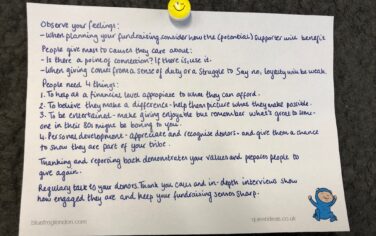
A guide to fundraising on the back of a postcard
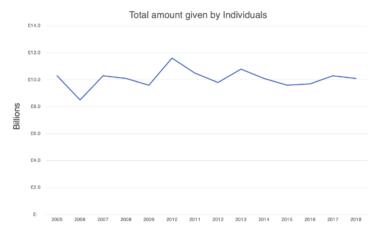
What does the latest research tell us about the state of fundraising?